
Private Christian School vs. Public School Near Sacramento: What El Dorado Hills Families Need to Know
An honest comparison for families who are serious about the decision.
Every year, families in El Dorado Hills sit down to have the same conversation. It usually starts with a question someone has been holding for a while: Are we sending our kids to the right school?
For Christian families, especially, that question carries weight. School is not just academics. It is sixteen thousand hours of your child's life. It shapes how they think, what they value, and whether they emerge ready to live with purpose. Getting it right matters.
This post is for families in the Sacramento foothills who are genuinely weighing their options. It is not a sales pitch for a private school. It is an honest look at what each path offers, where the real differences lie, and what the tuition conversation actually comes down to.

The Public Schools in El Dorado Hills Are Genuinely Good
This matters to say clearly and first: the public schools in El Dorado Hills are not failing schools. Oak Ridge High School ranks in the top 20 percent of all California schools for overall test scores, with math proficiency well above the state average. The school has a student-teacher ratio of 24:1 and offers a wide range of Advanced Placement courses. For a family whose primary goal is college preparation within a conventional academic model, Oak Ridge is a legitimate and respected option.
The Rescue Union School District, which covers El Dorado Hills at the elementary and middle school level, reports student-teacher ratios ranging from roughly 19 to 1 in transitional kindergarten up to nearly 29 to 1 in grades four and five.
So the choice between public and Private Christian schools near Sacramento is not a matter of good or bad. It is a choice between two different visions of what school is for. And that is a more interesting, more honest question to wrestle with.
What Public School Does Well
Public school, at its best, offers breadth. Large schools like Oak Ridge offer genuine advantages: diverse course offerings, competitive sports programs, robust arts programs, large peer communities, and college-preparation infrastructure that many families value.
Public school is also, practically speaking, free. That is not a trivial fact. For many families, redirecting thousands of dollars annually toward tuition is not a realistic option, and there is no shame in that.
What the public school model was designed to do, it generally does. It moves large numbers of students through a standardized curriculum, awards recognized credentials, and prepares most students for the next expected stage of life.
Where the Public School Model Has Real Limits
The same features that make public school broadly accessible also create structural constraints that are difficult to work around, regardless of how talented individual teachers are.
Individual attention is limited by design.
When one teacher is responsible for twenty-five to thirty students at a time, the learning experience is necessarily averaged. The brightest students in the room are often unchallenged. Students who process information differently or need more time are often left behind. The middle gets served; the edges do not.
Faith has no place in the building.
For a Christian family, this is not a minor footnote. It is a foundational issue. Public schools are legally required to be neutral on matters of faith. That means six or seven hours every day in an environment that treats your child's most important belief about who they are and why they exist as irrelevant to their education. For some families, that is acceptable. For others, it represents a meaningful cost.
The system rewards compliance over curiosity.
This is not a criticism of individual teachers. It is a structural reality. When you are managing thirty students and accountable to state standards, you need order. Order requires compliance. The most naturally curious, unconventional, and independently minded children frequently find this the hardest to navigate.
The goal is college, not purpose.
Public school, as a system, is organized around a fairly narrow definition of success: get good grades, score well on tests, and gain admission to a good college. That path works for some students. For others, particularly those trying to figure out who they are and what they are called to do, it can feel like running toward a destination that was chosen for them.
What a Private Christian School Near Sacramento Offers Instead
A private Christian school does not automatically solve every limitation of public schools. What it offers is a different set of priorities, and the quality of the experience depends entirely on how seriously the school takes them.
The best private Christian schools in the Sacramento foothills share certain commitments: smaller communities where students are known as individuals, faith integrated into the whole experience rather than added on, and a genuine attempt to educate the whole child, not just the academic portion.
What distinguishes schools within that category is their learning model. A traditional private Christian school may offer the same basic instructional approach as a public school, just with smaller class sizes and a Bible class on the schedule. A genuinely different kind of school takes the premise further.
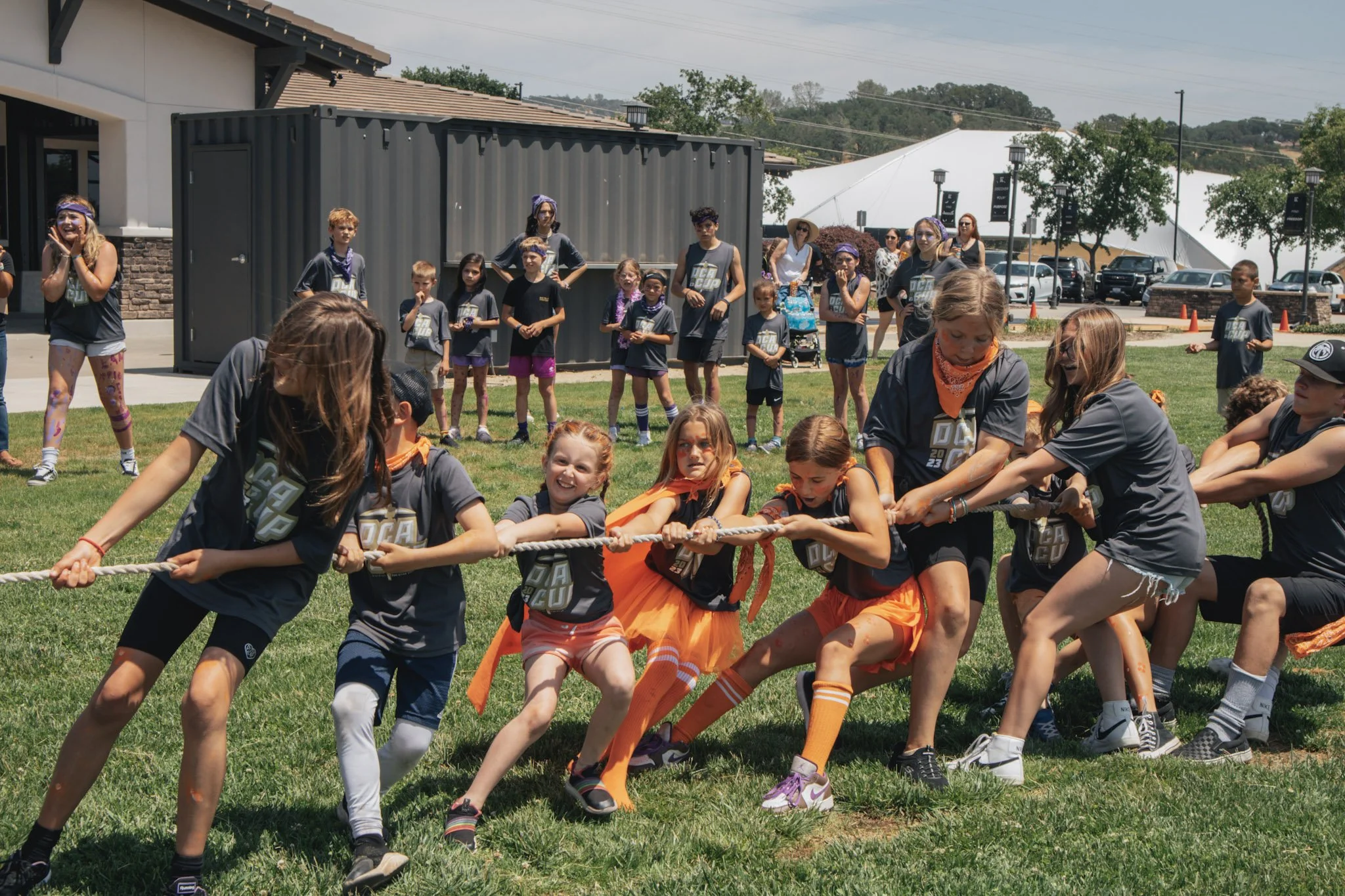
What The Academy at District Church Offers
The Academy at District Church is a K-12 Christian school located in El Dorado Hills. Its model is not a refinement of traditional schooling. It is a different approach built on a different set of convictions about how children actually learn.
The school operates on a student-driven, project-based, mentor-guided model. Students are not passive recipients of information delivered from the front of a room. They own their learning, pursue projects that engage their genuine interests, and develop accountability through the natural consequence of their own choices. Every day at The Academy includes devotions and community, focused academic work, real collaboration, and time to create and build things that matter.
The faith integration is foundational, not decorative. Students are not simply in an environment that tolerates their faith. They are in an environment built on the conviction that a meaningful education requires a Creator, that purpose comes from knowing that Creator, and that a child who understands who they are in Christ learns differently than one who does not.
The Tuition Conversation
This is usually where Christian families who are genuinely interested get stuck. And it deserves a direct response.
Tuition at a private Christian school near Sacramento is a significant investment. While the average private high school tuition in Sacramento County is lower than the broader California average, prioritizing a small community, a high mentor-to-student ratio, and a deeply intentional program naturally reflects a higher tier of investment.
The honest ROI question is not whether private school is "worth it" in the abstract. It is whether this specific environment, for this specific child, at this specific stage of life, produces something the alternative cannot.
School represents sixteen thousand hours of a child's life. That is not a metaphor. It is arithmetic. What happens in those hours matters. The question is not only what it costs to invest in the right environment. It is what it costs to spend those hours in the wrong one.
For families considering The Academy, the right framing is not "can we afford tuition?" It is "What do we want those sixteen thousand hours to produce?" If the answer is an independent thinker, a courageous leader, and a young person who knows their purpose and their Creator, then the comparison to a free public school is not really apples-to-apples.
An Honest Side-by-Side
Here is a direct comparison without overstatement on either side.
Public school near El Dorado Hills offers: no tuition, a large peer community, strong extracurricular programs, AP and college-prep coursework, and widely recognized academic credentials.
The Academy at District Church offers: Christ-centered education from the foundation up; a student-driven model designed to build genuine ownership and curiosity; mentor-guided learning in a small community where every student is known; a clear developmental arc from elementary through high school; and an environment that treats the family as the primary educator.
Neither is universally better. They are built for different families with different priorities.
How to Know Which Path Is Right for Your Family
A few questions worth sitting with:
Is faith a non-negotiable part of your child's education, or something you are comfortable addressing outside of school hours? Do you want your child to be challenged to think and own their education, or do you need a clearly mapped traditional path with familiar benchmarks? How is your child currently doing in school, not just academically, but in terms of curiosity, engagement, and sense of purpose? And honestly, what do you want school to produce in your child by the time they graduate?
There is no universal correct answer. The Academy is clear about this itself. It exists to serve a specific kind of family with a specific vision, not to recruit everyone.
If you are the kind of Christian family that believes school should cultivate independent thinkers and courageous leaders grounded in their faith, the public school down the street, however good it is, was not built for that goal. The Academy was.
The next step is simply to learn more. Watch the Info Session video on the homepage, ask your honest questions, and let the school help you figure out whether it is the right fit.
The Academy at District Church is a K-12 Christian school located at 7000 Rossmore Lane, El Dorado Hills, CA 95762. Call 916.857.9100 to learn more.
FAQs
-
The primary difference lies in their foundational goals and learning models. Local public schools offer a standardized, compliance-driven education focused on mass instruction and traditional college prep. In contrast, The Academy at District Church provides a Christ-centered, student-driven education focused on discovering individual purpose, small mentor-guided communities, and project-based learning.
-
For families at The Academy at District Church, the investment is measured by the return on the 16,000 hours a child spends in school. While public school is practically free, tuition at a genuinely intentional private Christian school provides a highly customized, faith-integrated environment designed to cultivate independent thinkers and courageous leaders, which many families find to be an invaluable return on investment.
-
Public schools are legally required to remain neutral on matters of religion, removing faith entirely from the educational day. At a private Christian school like The Academy at District Church in El Dorado Hills, faith is not just a separate class; it is the foundation of the entire curriculum, teaching students that their education, identity, and real-world purpose are deeply connected to their Creator.
-
Traditional public school models often reward compliance, standardized testing, and sitting still, which can easily suppress a child's natural curiosity. The student-driven model at The Academy at District Church combats disengagement by empowering students to take real ownership of their learning, tackle meaningful, real-world projects, and understand the actual purpose behind their daily education.
-
The best way for families in the Sacramento foothills or El Dorado Hills to evaluate if The Academy at District Church is the right fit is to watch the comprehensive online Info Session video on their homepage. It provides a highly transparent view of their unique, Christ-centered, learner-driven model, helping parents make an informed and confident educational decision.
